
We often discuss the cutting-edge technology powering telecom networks, such as fiber speeds, 5G latency, and immense bandwidth. But when you look behind the curtain at how that network is documented, you often find a reality that is much less advanced than the technology it describes. It is surprising how much room for improvement exists in network documentation, considering that a relatively small effort here can yield huge business benefits.
For many operators, even large Tier 1 and Tier 2 providers in advanced markets, the physical network inventory remains trapped in tens, if not hundreds, of thousands of static files. This stands in stark contrast to the dynamic, constantly changing state of the actual fiber network. Highly skilled technicians still spend their days manually searching for, inspecting, and updating CAD maps, Visio schematics, and Excel splice tables spread across servers, departments, and locations.
This reliance on manual documentation creates a cascade of inefficiencies that affects the entire business:
Unknown asset value
You cannot easily query the system to estimate the true financial value of your network assets if the data is spread across thousands of files that only humans can interpret. Estimating the value of your infrastructure becomes a manual burden of counting devices and calculating cable lengths by hand.
Blocked AI strategy
Owners and leadership teams are demanding to leverage AI technologies, but without structured, clean, accurate, and centrally governed data, a true AI strategy is impossible to implement. Feeding a model incomplete or unstructured data leads to unreliable outputs, making it dangerous to rely on for operational decisions. According to industry research, this represents a major risk. Companies often invest significant time and effort into implementing AI, only to find no meaningful optimization results in the end, simply because the data foundation was flawed.
Revenue loss
Sales teams cannot market what they cannot see. Imagine you complete an aggressive 80-kilometer build in a high-density business district. You invested millions in construction, yet due to delays in processing as-built documentation, this new capacity remains trapped in field sketches, invisible to your commercial teams. The network exists physically, but not digitally. A simple calculation reveals the irony: you are losing millions in recurring annual revenue on "unsellable" assets, simply because the network is not in the system, a loss that vastly outweighs the cost of documenting it correctly.
Hindered operations
The network changes today, but the documentation is often updated weeks, sometimes months later. These delays directly impact the bottom line. For example, critical decisions like troubleshooting a business subscriber with strict SLAs are effectively not data-driven if there is no documentation available yet. Similarly, planning network extensions, executing maintenance tasks (such as relocating cables), and provisioning new customers all require up-to-date, accurate, and reliable physical network documentation immediately at hand. This data must be centralized and queryable, not scattered across folders and multiple file versions.
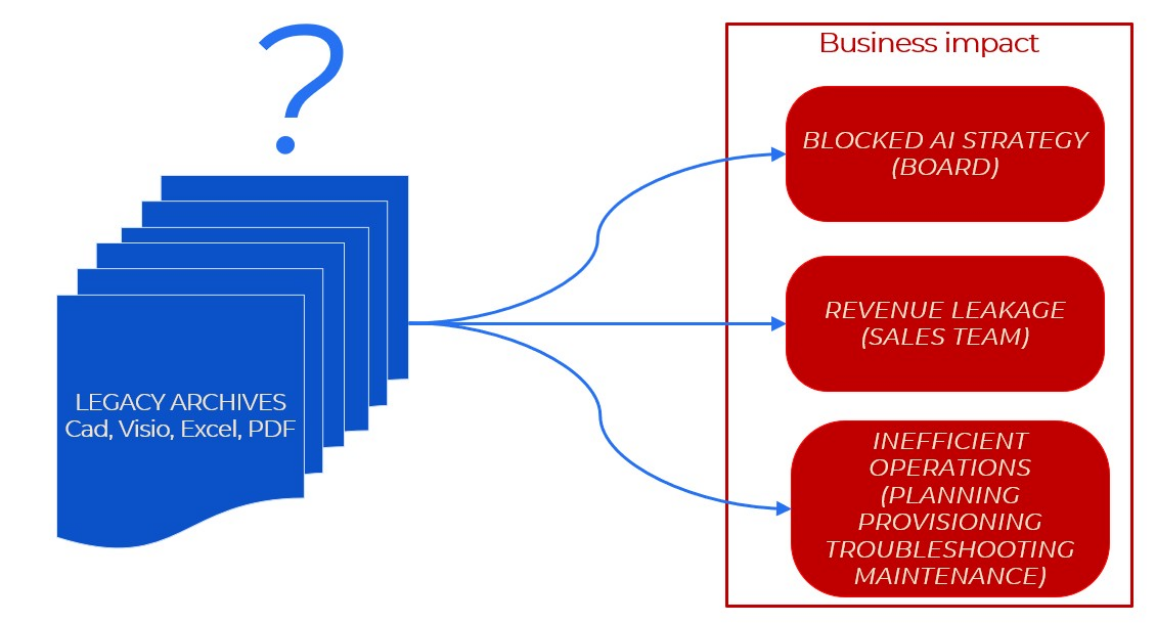
Business impact of Legacy Network Inventory
Conclusion
From a pure business perspective, you must ask yourself: Is this sustainable? In a competitive market demanding agility, will this operational friction cause me to fall behind?
While the situation seems daunting, there are effective measures to turn this around. It starts with a proper physical network data digitization strategy. We will explore how to tackle this challenge in our next post.